

Etara Open-Air Museum by Car: Bulgaria’s Living History Village and Watermill Route
Etara Open-Air Museum by Car: Bulgaria’s Living History Village
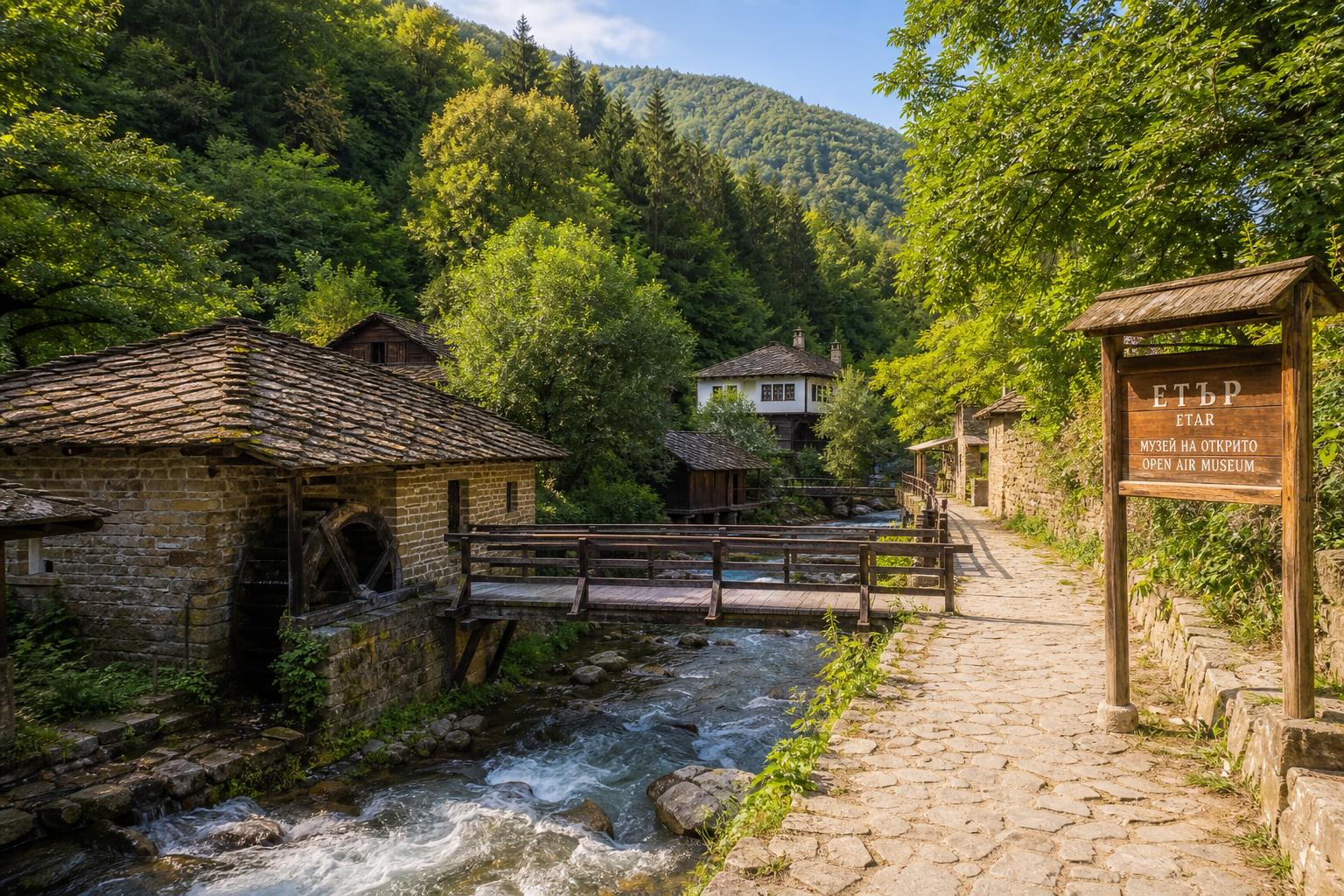
The Etara Open-Air Museum sits 8 km south of Gabrovo in central Bulgaria, perched above the Sivek River in a narrow forested gorge. It’s the only open-air museum in the Balkans with working water-powered machinery — a row of watermills, fulling mills, a bark-boiler, a wood-turning lathe and a smithy, all driven by the stream that runs through the complex. If you’re exploring central Bulgaria by rental car, Etara is one of the most rewarding half-day stops on the route between Veliko Tarnovo and the Rose Valley.
Getting There by Car
From Sofia
The drive from Sofia to Etara covers roughly 220 km and takes about 2 hours 45 minutes. Take the A1/E773 east to the Banya turn-off, then follow the I-5 through Stara Zagora and north on road 5006 to Gabrovo. The final 8 km follow a well-maintained two-lane road south from Gabrovo’s centre. Fuel up in Gabrovo — there’s a Lukoil station on the roundabout near the hospital — as there are no fuel stops between the town and the museum.
From Plovdiv
The Plovdiv route is roughly 160 km and takes about 2 hours 15 minutes. Head north on road 6 through Karlovo and the Shipka Pass (1,330 m), then continue through Gabrovo. The Shipka section has tight hairpins and no barrier on the mountain side — drive carefully in wet weather. In winter (December through March), snow chains are mandatory on this stretch.
From Veliko Tarnovo
Veliko Tarnovo is the closest major city at about 40 km and 45 minutes. Take road 5006 south through Dryanovo and Gabrovo. The road is in good condition, two lanes with occasional overtaking sections. This is the most practical base if you want to combine Etara with a visit to the Tsarevets Fortress in the same day.
From Varna
The drive from Varna is about 270 km and 3 hours 15 minutes via the A2 west to Shumen, then south through Targovishte and Veliko Tarnovo. It’s a full day trip from the coast — consider staying overnight in Veliko Tarnovo instead.
Parking at Etara
Etara has a dedicated free car park at the entrance, capacity roughly 80-100 vehicles. On summer weekends and public holidays (especially around the annual Etara Crafts Fair in early September), this car park fills by 10:30. An overflow gravel lot across the road adds another 40-50 spaces. There’s no parking fee at either lot.
If both are full, you can park along the roadside north of the entrance for about 200 metres, but the shoulder is narrow and the road has pedestrian traffic. Disabled drivers will find two marked bays right next to the ticket booth. The car park surface is compacted gravel — fine for standard rentals, though low-slung sports cars may scrape on the speed bumps at the entrance.
What You’ll See at Etara
The museum occupies a reconstructed 19th-century Bulgarian village along both banks of the Sivek River. The lower path follows the watermills — the highlight of any visit. Each mill is in working order and demonstrations run throughout the day:
- Watermill for flour — the oldest and most photographed, still grinding wheat into flour that the on-site bakery uses for its bread.
- Bark-boiler — a rare water-powered device used to process animal hides, one of only a few surviving examples in Europe.
- Fulling mill — used to beat woven woollen cloth into felt, a process called fulling that takes several hours.
- Wood-turning lathe — water-driven, producing wooden bowls and utensils that are sold in the craft shops.
- Smithy and pottery workshop — live demonstrations on most days in season.
The upper level houses about 50 exhibit buildings including a school, a church, a bakery, a furrier’s workshop, a cutlery shop and several taverns. The cobbled streets are uneven but walkable in regular shoes — skip the heels.
Practical Tips for Your Visit
- Opening hours: April through October, 8:30-17:30 daily. November through March, 9:00-16:30. Closed on major Orthodox holidays (check ahead).
- Entry fee: 5 BGN for adults (about 2.50 euro). Children under 7 free. Photography is allowed without extra charge.
- Time needed: Allow 2-3 hours for a proper visit. The craft workshops close at 16:00 in winter, so arrive by midday.
- Food: The in-museum tavern serves traditional Bulgarian dishes — bean soup, grilled meats, shopska salad — at reasonable prices (15-25 BGN per main). There’s also a coffee shop by the entrance.
- Cash: Bring cash. The ticket booth and taverns accept BGN only. The nearest ATM is in Gabrovo.
- Best time to visit: Late April through June for comfortable temperatures and green scenery. September for the annual crafts fair (first weekend). Avoid midday in July-August when the gorge gets humid and the watermill path is crowded.
Day Trips from Etara by Car
Etara sits at the heart of several worthwhile stops within a 30-60 minute drive, making it easy to combine into a full day trip:
- Dryanovo Monastery — 15 minutes east on road 5006. A clifftop monastery founded in the 13th century, rebuilt after the April Uprising. Free parking, 20-minute visit.
- Sokolski Monastery — 10 minutes south of Etara on the same road toward Shipka. Set in a forest clearing with a spring believed to have healing properties.
- Shipka Pass and Memorial Church — 45 minutes south through Gabrovo. The golden-domed Russian Orthodox church commemorating the Russo-Turkish War is one of Bulgaria’s most photographed landmarks. See our Plovdiv to Veliko Tarnovo drive guide for the full route through the pass.
- Tryavna — 20 minutes northeast. A charming Revival-era town famous for woodcarving and icon painting. Well worth the detour for its cobbled Samuilov Street and Daskalov House museum.
- Veliko Tarnovo — 45 minutes north. Bulgaria’s medieval capital, with the Tsarevets Fortress and the cobbled Gurko Street overlooking the Yantra River bend. Our Veliko Tarnovo car rental page has pickup details.
Road Conditions and Driving Tips
Roads to Etara from all major cities are paved and generally in good condition. The Gabrovo-to-Etara stretch (8 km) is narrow and winding through a forested gorge — keep to the right on bends and watch for pedestrians walking along the roadside. In winter, this road can ice over as it follows the river valley; if there’s been snow, check conditions before setting out.
Fuel in the region costs around 3.10-3.40 BGN per litre (1.55-1.70 euro). Gas stations in Gabrovo are reliable, but smaller villages between the city and the museum have none. Bulgarian motorways require a vignette, available at border crossings, petrol stations and online. The A1 between Sofia and Banya is a toll-free section, but the A2 from Varna west to Shumen requires a valid vignette.
A compact car is perfectly adequate for the Etara route — no high clearance or 4WD needed. If you’re combining Etara with a winter trip through the Shipka Pass, consider a mid-size with decent tyres.
Explore Central Bulgaria by Car
Etara is one of Bulgaria’s most accessible and rewarding day trips by car — a working museum where the water still turns the mills and the craftspeople still sell what they make. Combined with Dryanovo Monastery, Tryavna or the Shipka Pass, it makes a full day that most visitors miss because they never leave the coast.
For more driving routes and practical tips across Bulgaria, see our guides to renting a car in Bulgaria for first-timers, car rental in Veliko Tarnovo and car hire from Sofia Airport.
Ready to book? Visit our homepage for the best hire car deals.