

Plovdiv to Veliko Tarnovo Drive: Bulgaria’s Ancient Capitals Road Trip
Connecting Bulgaria’s two most storied cities by car is one of the best road trips you can do in the country. You start in Plovdiv, Europe’s sixth-oldest continuously inhabited city, and finish in Veliko Tarnovo, the medieval capital that once ruled an empire stretching from the Black Sea to the Adriatic. The drive itself is only about 220 kilometres, but the route threads through mountain passes, rose valleys, and half-forgotten villages that most tourists never see.
If you are picking up a car in Plovdiv, the downtown offices around Tsar Boris III Boulevard and the railway station area are convenient, though Sofia Airport tends to have a wider selection of vehicles and better weekend rates. Wherever you collect it, make sure your rental includes unlimited kilometres — this is a long day of driving with plenty of detours.
The Route at a Glance
| Leg | Distance | Time | Road |
|---|---|---|---|
| Plovdiv to Karlovo | 65 km | 1h | A1 motorway, then Route 64 |
| Karlovo to Shipka Pass | 45 km | 1h 15min | Route 6, mountain road |
| Shipka Pass to Veliko Tarnovo | 55 km | 1h 10min | Route 55, then E772 |
| Total (direct) | ~220 km | 3h 30min |
The direct route along the A1 and through Shipka Pass is the fastest and most scenic. In winter, if Shipka is snowed in, the longer alternative via Kazanlak and Route 55 adds about 40 minutes but stays at lower elevation.
Stop 1: Karlovo and the Rose Valley
About an hour north of Plovdiv, Karlovo sits at the southern edge of the Rose Valley. If you are travelling in late May or early June, the fields around here turn into a carpet of pink Damascus roses, and the air smells like distilled perfume. Even outside bloom season, Karlovo is worth a stop for its old-town houses and the birthplace museum of Vasil Levski, Bulgaria’s national hero.
There is a large paid parking lot on Vasil Levski Street near the museum complex — about 2 leva per hour. The old town’s cobbled streets are narrow; a compact car is far more practical than an estate here. If you are driving a larger vehicle, park at the lot and walk the ten minutes to the centre.
Stop 2: Kazanlak and the Thracian Tombs
Another twenty minutes northeast, Kazanlak is famous for two things: rose oil production and Thracian tombs. The Kazanlak Tomb, a UNESCO World Heritage site, is a small but extraordinary 4th-century BC burial chamber with intact frescoes. Entry is 6 leva, and photography without flash is allowed. Parking is on the street outside — usually free, though it fills quickly on summer weekends.
If you have time, the Valley of the Thracian Kings extends east from here with several more tomb complexes. The most impressive, Shushmanets and Helvetia, are signposted from the main road but require a short drive on unsealed farm tracks. A compact SUV or crossover handles these comfortably; a low-slung saloon will struggle after rain.
Stop 3: Shipka Pass and the Freedom Monument
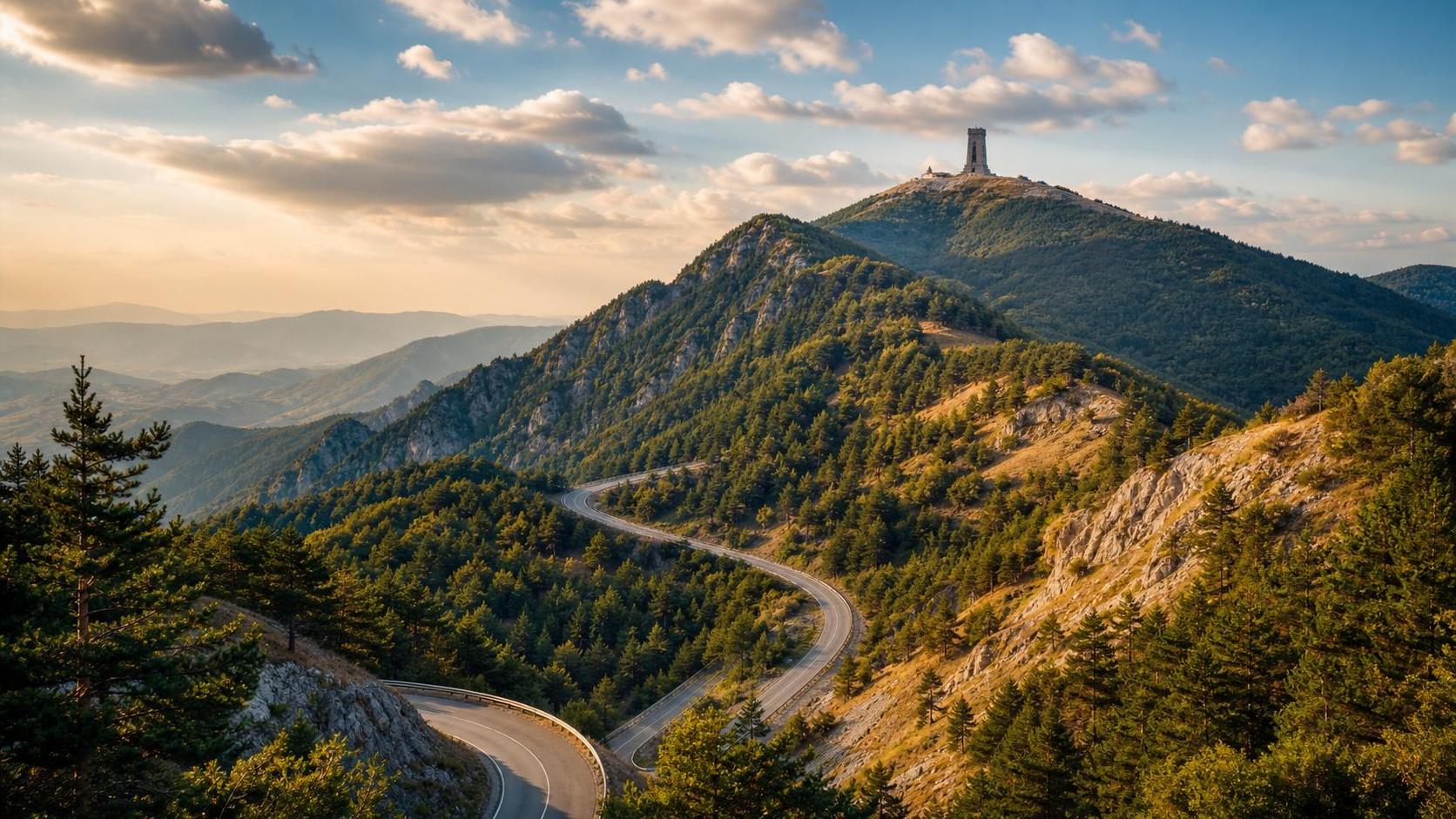
The climb from Kazanlak to Shipka Pass is where this drive becomes spectacular. The road switchbacks through beech and pine forest, emerging at 1,150 metres with views across the entire Balkan range. The Shipka Memorial, a granite lighthouse-shaped monument, commemorates the 1877 battle that proved decisive in Bulgaria’s liberation from Ottoman rule. You can climb the 894 steps to the top — the view on a clear day stretches from the Sredna Gora mountains to the Danube plain.
There is a large car park at the base of the monument, free but unshaded. In July and August it fills by 11:00 am with tour buses; arrive before 10:00 am or after 4:00 pm for a quieter visit. The gift shop at the bottom sells surprisingly good local honey and rose oil at prices lower than Sofia tourist shops.
Driving note: The pass is properly maintained but steep and twisting. In winter, snow chains are legally required between November and March, and the pass closes entirely after heavy snowfall. Check Bulgaria winter driving conditions before you set out.
Arriving in Veliko Tarnovo
The descent from Shipka into the Yantra River valley is dramatic — the road clings to the hillside with the river far below, and Veliko Tarnovo appears suddenly across the gorge, its terraced houses stacked like a medieval amphitheatre. The Old Town is mostly pedestrianised; if your accommodation is inside the historic quarter, arrange to park at your hotel or use the municipal lot on Vasil Levski Street.
Veliko Tarnovo’s Tsarevets Fortress is the headline attraction, and rightly so. The sound-and-light show runs most summer evenings and is genuinely impressive. For a quieter experience, walk across the river to the Church of SS. Peter and Paul — a 13th-century ruin with medieval frescoes that most visitors miss entirely.
Practical Driving Tips for This Route
- Fuel: Petrol stations are frequent on the A1 but sparse on Route 6 through the mountains. Fill up in Karlovo or Kazanlak before the Shipka climb. Unleaded 95 costs roughly 2.90–3.10 leva per litre (about €1.50).
- Tolls: The A1 requires a vignette — buy one at any petrol station before entering the motorway. A weekend vignette (Friday to Sunday) costs 15 leva; a weekly vignette is 30 leva.
- Speed limits: 140 km/h on the A1, 90 km/h on main roads, 50 km/h through villages. Police radar is common near Kazanlak and on the E772 approach to Veliko Tarnovo.
- Road surface: Generally good on main routes. The Kazanlak–Shipka section was resurfaced in 2024. Farm tracks to Thracian tombs can be rough after rain.
- Phone signal: Patchy in the Shipka Pass area. Download offline maps before you leave Plovdiv.
Extending the Trip
If you have an extra day, the obvious extension is north to Ruse on the Danube, then west to Pleven and back to Sofia. Alternatively, head east from Veliko Tarnovo to the Black Sea coast — Sunny Beach is about three hours via the E772 and A1. For mountain lovers, the reverse route through the Borovets ski area and back to Bansko makes a superb loop through Bulgaria’s highest peaks.
What Car Do You Need?
For the direct route, a compact hatchback is perfectly adequate. If you plan to explore the Thracian tombs on dirt tracks or visit in winter, opt for a crossover or small SUV. Manual transmission is standard in Bulgaria; automatics are available but book ahead, especially in summer. The Plovdiv car hire offices have the best selection, though Sofia Airport usually beats them on price for longer rentals.
Related Destinations
Looking for more Bulgarian road trips? Also explore our guides to the Sofia to Plovdiv scenic route, Plovdiv to Bansko mountain drive, and Bulgaria’s best scenic driving routes.
Frequently Asked Questions
How long is the drive from Plovdiv to Veliko Tarnovo?
The direct route is about 220 kilometres and takes 3.5 hours without stops. With the recommended stops at Karlovo, Kazanlak, and Shipka Pass, plan for a full day of 6 to 8 hours.
Is Shipka Pass open all year?
Technically yes, but heavy snow can close it temporarily between December and February. Snow chains are mandatory in winter. The alternative via Kazanlak and Route 55 is lower and usually stays open.
Can I do this trip in one day?
Yes, though it is a long day. If you want to explore the Thracian tombs properly and visit Tsarevets Fortress in Veliko Tarnovo, an overnight stay in Veliko Tarnovo is far more comfortable.
Do I need a 4×4 for this route?
No — the main roads are paved and well maintained. A 4×4 is only useful if you plan to drive the unsealed tracks to remote Thracian tombs or visit in winter when snow is likely.
Is the A1 motorway tolled?
Yes, vignettes are required for all motorways in Bulgaria. Buy one at any petrol station or at the motorway entrance. The weekend vignette (Friday–Sunday) costs 15 leva.
Where should I hire the car?
Plovdiv is convenient if you are already in the city, but Sofia Airport typically has better rates and a wider vehicle selection. For a longer Bulgarian road trip, consider a one-way rental — many suppliers allow drop-off in Veliko Tarnovo for a modest surcharge.
Ready to book? Visit our homepage for the best hire car deals.