

Renting a Car in Sofia: Your Complete Guide to Driving Bulgaria’s Capital
Why Renting a Car in Sofia Actually Makes Sense
Sofia gets underestimated as a city. Most people pass through on the way to the mountains or the coast, spend two nights, and move on. But if you have a hire car, the whole calculus changes. Rila Monastery, Plovdiv, the Rhodopes — all of it opens up, and none of it is easily done by public transport without a lot of waiting around.
The city itself is very driveable by European capital standards. It’s not Vienna, but it’s also not Athens. If you’ve driven in any mildly chaotic city before, Sofia won’t stress you out. The main thing to know upfront is that it rewards some preparation — get the vignette sorted, understand the parking zones, pick the right terminal to collect your car — and the rest comes naturally.
Here’s the full picture.
Picking Up Your Car at Sofia Airport — T1 vs T2
Sofia Airport has two terminals, and they are not connected. This trips up a lot of people. Terminal 1 is the older building — it handles some charter flights and older scheduled routes. Terminal 2 is the main terminal, opened in 2006, and where most international flights (Ryanair, Wizz Air, British Airways, Lufthansa, etc.) arrive.
If you’re flying in on a budget airline, you’re almost certainly landing at T2. The car hire desks at T2 are in the arrivals hall on the ground floor — you’ll see them as you come out. Most of the main names are represented there: Hertz, Europcar, Avis, Budget, and local operators.
At T1, the car hire counters are smaller and not all operators are present. If you’ve booked through BG Car Rental at Sofia Airport, check your confirmation email carefully for which terminal and where to meet. When in doubt, call ahead — a 2-minute phone call saves a 20-minute taxi between terminals.
Fuel tip: the airport has a petrol station on the access road as you leave. Fill up there before heading into the city if your tank isn’t full — it’s cheaper than central Sofia and saves you hunting for a station when you’re navigating unfamiliar streets.
Driving in Sofia City Centre
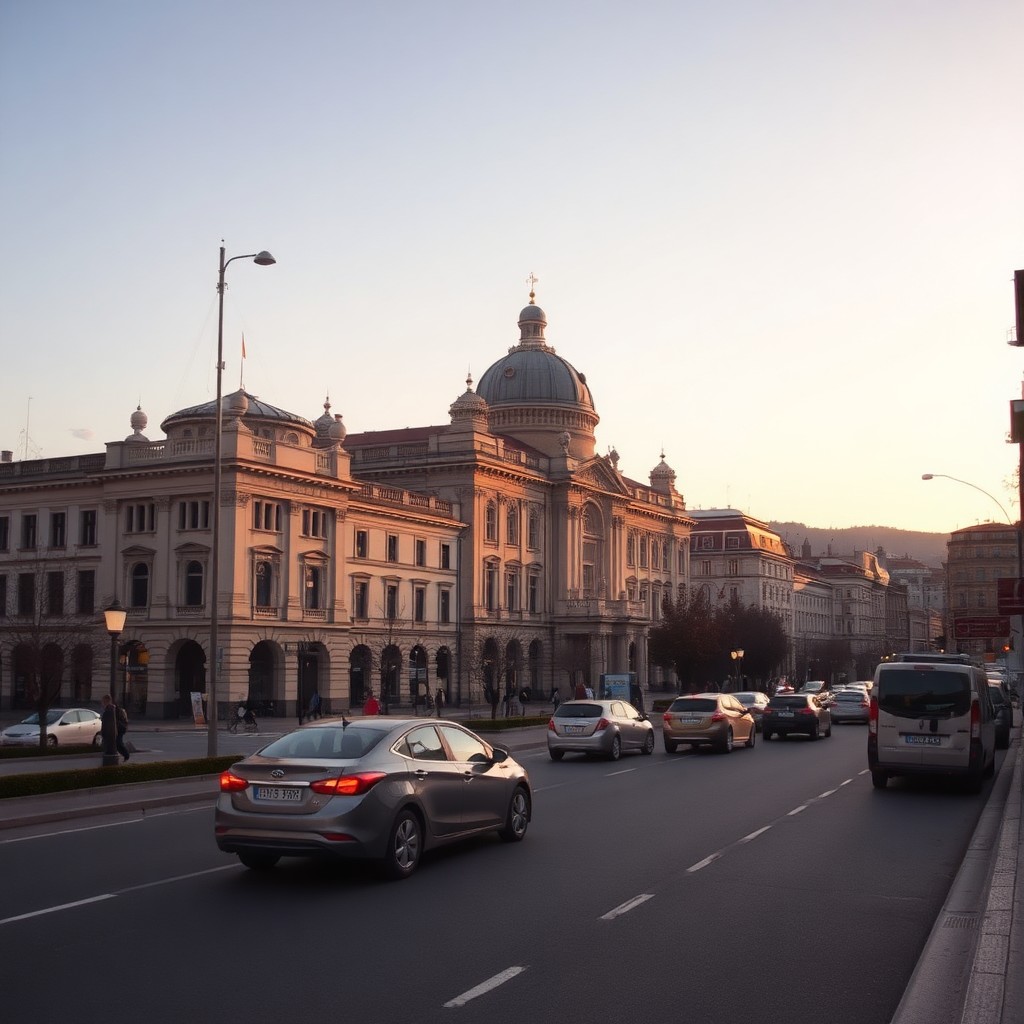
The city has a ring road (the Околовръстен Път — good luck with the pronunciation) that loops around the urban area. If you’re driving through Sofia rather than stopping, use the ring road and skip the centre entirely. It’s well-signed and keeps you clear of the one-way systems and tram lines downtown.
For actually driving in the city, a few things to know:
- Trams: Sofia has an old tram network and it is not shy about it. Trams run on dedicated tracks in the middle of major roads, but sometimes the lanes are tight and tram stops are in the lane of traffic. When a tram stops to pick up passengers, you have to stop behind it — do not pass on the right side, passengers step directly into the road.
- Old city cobblestones: The area around Vitosha Boulevard, Aleksandar Nevski Cathedral, and the old centre has cobblestone streets. They’re fine at low speed, but wet cobblestones get slippery. Take it easy, and if you’ve got a small car with low-profile tyres, watch for uneven sections.
- Parking zones: Sofia runs a blue and green zone parking system in the centre. Blue zone is the inner core (most expensive, 90-minute max), green zone is slightly wider. You pay via SMS or the Ring parking app. Machines also exist at most streets. The mobile app is the easiest — download Ring before you arrive. Rates are around 1.50-2 BGN per hour (roughly €0.75-€1). Enforcement is real — wardens are active on weekdays especially.
- Bul. Vitosha area: The main pedestrian street (Vitosha Boulevard) is fully pedestrianised. The streets around it get congested during peak hours. If you’re heading to a hotel near the centre, check whether there’s hotel parking available — many have underground car parks that are worth the few euros a day.
The Bulgarian Vignette — Don’t Skip This
Bulgaria charges a road tax (vignette) for using the national road network. This is not optional. If you’re caught without one, the fine starts at 300 BGN.
The vignette is a digital sticker — your registration plate is logged in a database. You buy it at border crossings, petrol stations, or online at bgtoll.bg. A weekly vignette costs 15 BGN (about €7.50). A monthly one is 30 BGN. If you’re renting a car, check whether the rental company has already included the vignette — some do, some don’t. Ask explicitly, don’t assume.
Note: the vignette covers national roads but not the Trakia Motorway (Sofia to Burgas) or the Hemus Motorway (Sofia to Varna). Those have electronic toll points and charge separately. More on that below.
Day Trips from Sofia by Car
This is where having a hire car really pays off. Sofia sits in a basin surrounded by mountains, and some of Bulgaria’s best sights are within 2 hours in any direction.
Vitosha Mountain — 20 minutes
The mountain that forms Sofia’s backdrop. You can drive to the Dragalevtsi or Simeonovo neighbourhoods (south side of the city) and be at the forest edge in 20 minutes from the centre. There are trails ranging from easy walks to the Cherni Vrah summit (2,290m). The Kopitoto area has a car park and a few restaurants. Good for a half-day if you want fresh air without committing to a long drive.
Boyana Church — 20 minutes
UNESCO-listed medieval church at the foot of Vitosha, about 8km from the city centre. The 13th-century frescoes inside are genuinely world-class — considered among the finest examples of medieval painting in Europe. The viewing is in small groups and timed (book ahead), so don’t just turn up and expect to walk straight in. Combine it with a Vitosha walk for a full morning.
Plovdiv — 2 hours
Bulgaria’s second city and, honestly, the more charming of the two. The old town sits on three hills with 19th-century Revival-period houses, an intact Roman amphitheatre, and a genuinely good food and bar scene. Take the Trakia Motorway east from Sofia — it’s about 140km and the road is fast and easy. Allow a full day. Plovdiv has car parks at the foot of the old town hills.
You can also book car hire in Plovdiv directly if you’re basing yourself there, but for a day trip from Sofia, you won’t need to.
Rila Monastery — 2 hours
The big one. Bulgaria’s most visited monument, and for good reason — Rila Monastery sits in a mountain valley at 1,147m and is genuinely spectacular. The drive from Sofia is about 120km, mostly on a good national road through the Rila Mountains. Take the E79 south towards Blagoevgrad, then turn off at Kocherinovo and follow signs up the valley. The monastery has a large car park. Arrive early (before 10am) to avoid the tour groups. Allow 3-4 hours including the drive and time to walk around.
Fuel Costs in Bulgaria
Bulgaria has some of the cheapest fuel in the EU. As of early 2026, petrol (A95) runs around 2.40-2.60 BGN per litre (roughly €1.20-€1.30). Diesel is slightly cheaper. This is noticeably lower than Western Europe, so if you’re coming from Germany or the UK, you’ll feel the difference immediately.
Petrol stations are plentiful on the main roads. Shell, Lukoil, OMV, and local chains (Petrol, Eko) are all reliable. On mountain roads, stations are less frequent — fill up before heading into the Rila or Rhodope mountains.
Road Rules Worth Knowing
- Speed limits: Urban areas — 50km/h. National roads — 90km/h. Motorways — 140km/h. These are actively enforced with cameras and mobile speed traps. Don’t assume that because roads are empty you won’t get caught.
- Alcohol limit: 0.05% blood alcohol. Stricter than the UK. Don’t risk it.
- Seatbelts: Mandatory front and back.
- Headlights: Compulsory 24/7, all year round. Even in summer daylight. This catches many foreign drivers.
- Winter tyres: Required from November 1 to March 1 if there is snow or ice. If you’re renting in winter, confirm the hire car has winter tyres — any reputable Bulgarian operator will have them fitted.
- Mobile phones: Hands-free only. Fine if caught using handheld.
If you’re planning to explore beyond Bulgaria, a sister site like 365carhire.com covers rental options across Europe including Greece, Romania, and further afield — useful if you’re doing a longer Balkans road trip.
What to Actually Watch Out For
A few things that don’t make it into the standard travel guides:
- Potholes on secondary roads: Main roads are generally fine. But get off the motorway onto regional roads and the quality drops fast. This is especially true in rural areas and mountain approach roads. Drive at a sensible speed and watch for unmarked holes, especially at night.
- Animals on roads: Dogs, horses, and the occasional cow on rural roads, especially in the Rhodope and Stara Planina areas. This is not a joke.
- Parking fines: Sofia parking wardens are systematic. If you park in a blue zone without paying, you will get a ticket. If you leave it long enough, you get a wheel clamp. Both are a hassle you don’t need on a holiday.
- Navigation: Google Maps works fine throughout Bulgaria. Download an offline map before you head into mountain areas where signal can drop.
FAQ
Is it easy to park in Sofia?
It depends where you are and when. In the centre during weekday office hours, finding a spot takes patience. The blue zone around Vitosha Boulevard and NDK is the hardest. Underground car parks (at The Mall, Arena di Serdica, and some hotels) are easier and cost around 2-3 BGN per hour. Outside the centre it’s much simpler — residential areas generally have free parking. On weekends, central parking loosens up considerably.
Do I need an international driving licence in Bulgaria?
If your driving licence is issued by an EU country, no — your standard EU licence is fully valid. If you’re from the UK, US, Australia, or most other countries, you technically should carry an International Driving Permit (IDP) alongside your national licence. In practice, car hire companies will usually accept a standard national licence from these countries, but for police checks or any incident, having the IDP protects you. Get one before you travel — it takes about 15 minutes at a post office or motoring club.
What are the toll roads in Bulgaria?
Bulgaria has a vignette system for the general road network (buy at border, petrol station, or bgtoll.bg). In addition, specific motorway sections have electronic tolls: the Trakia Motorway (A1, Sofia to Burgas) and the Hemus Motorway (A2, Sofia towards Varna) charge per kilometre. Toll gantries are overhead — your plate is read automatically. If you rent a car, ask the rental company how tolls are handled — some include a transponder, others settle tolls from your card after return. There are no toll booths to stop at.
Can I drive to North Macedonia from Sofia?
Yes, it’s about 165km from Sofia to Skopje and the drive takes around 2-2.5 hours. The main border crossing is at Gyueshevo/Deve Bair. Most car rental agreements allow you to cross into North Macedonia — but you must confirm this with your rental company before you go, as some operators restrict cross-border travel or require additional paperwork and insurance. Don’t assume it’s included; ask explicitly and get it in writing.
What’s the speed limit on Bulgarian motorways?
140km/h. This is higher than most of Western Europe and it’s real — you’ll see Bulgarian drivers using it. However, speed camera enforcement is active on motorways, particularly on the Trakia and Hemus. Stick to the limit and you’ll have no issues. Note that in fog, rain, or poor visibility there are lower advisory limits posted on overhead signs.