

Plovdiv Day Trips by Car: 5 Best Drives from Bulgaria’s Oldest City | From €15/day | Bgcarrental
Why Use Plovdiv as Your Base for Bulgarian Day Trips?
Plovdiv sits at the geographic heart of Bulgaria, and that central position makes it arguably the best base in the country for day trips by car. Within an hour’s drive you’ve got Roman ruins older than anything in Sofia, Bulgaria’s finest wineries, Thracian tombs from the 4th century BC, and one of the most spectacular mountain roads in the Balkans. Most visitors to Bulgaria land in Sofia and never leave the west, but Plovdiv — just 90 minutes east via the A1 — gives you access to a completely different Bulgaria. Pick up your hire car in Plovdiv and the Thracian valley spreads out in every direction, with no hidden fees and no traffic jams — just open roads into the Rhodope Mountains and the Rose Valley.
Compare trusted suppliers and book your Plovdiv car rental — prices start from around €15/day with free cancellation on most bookings.
Day Trip 1: Bachkovo Monastery and Asen’s Fortress (45 km round trip, half-day)
The closest and easiest day trip, and the one every visitor to Plovdiv should do first. Bachkovo Monastery is Bulgaria’s second-largest Orthodox monastery, founded in 1083 by Georgian monks. The drive south from Plovdiv takes about 25 minutes on the well-paved road towards Smolyan, winding through the Rhodope foothills with the dramatic limestone cliffs of the gorge rising on your left. Park in the large car park below the monastery (free) and walk up to the main complex — the frescoes in the church of Sveta Bogoroditsa date from the 17th century and the icon of the Virgin Mary is believed to be miracle-working by Bulgarian Orthodox faithful.
From Bachkovo, drive 10 minutes back north to the turn-off for Asen’s Fortress. Perched on a jagged rock pinnacle overlooking the Asenitsa River, the fortress was built in the 13th century by Tsar Ivan Asen II and the views from the top are some of the best in the Rhodopes. The climb is steep — about 15 minutes on a dirt path — but well worth it. The fortress ruins and the Church of the Holy Mother of God inside the walls are free to visit.
Time needed: 4–5 hours including lunch. Stop at the roadside stalls near Bachkovo for homemade honey and Rhodope mountain tea on the way back.
Day Trip 2: Starosel Thracian Tomb and Hisarya Roman Ruins (130 km round trip, full day)
The Thracian cult complex at Starosel is the largest discovered in Bulgaria — a royal tomb dating from the 5th–4th century BC, built into a hilltop with a 100-metre-long stone corridor leading into a circular burial chamber. It was discovered in 2000 and is still relatively unknown to international tourists. From Plovdiv, drive north on the road to Karlovo, then cut west through the villages of Banya and Starosel — about 1 hour 15 minutes total. The site is a 10-minute walk from the car park and entry costs 5 BGN (€2.50).
From Starosel, Hisarya is a 20-minute drive east. This spa town was a major Roman settlement — Diocletianopolis — and the 4th-century city walls are some of the best-preserved Roman fortifications in Bulgaria, running for 2.3 km around the old town with several gates still standing. Hisarya is also famous for its mineral springs — 22 of them, ranging from 37°C to 51°C. The public fountains in the town park run 24/7 and you can fill water bottles for free. For lunch, the National Restaurant in the central park does excellent Bulgarian grilled meats and shopska salad with a view of the Roman walls.
Time needed: 6–7 hours. Combine with a visit to the Starosel Winery (10 minutes from the tomb, tastings from 15 BGN/person) if wine is part of the plan.
Day Trip 3: Koprivshtitsa — Bulgaria’s Most Beautiful Revival Town (210 km round trip, full day)
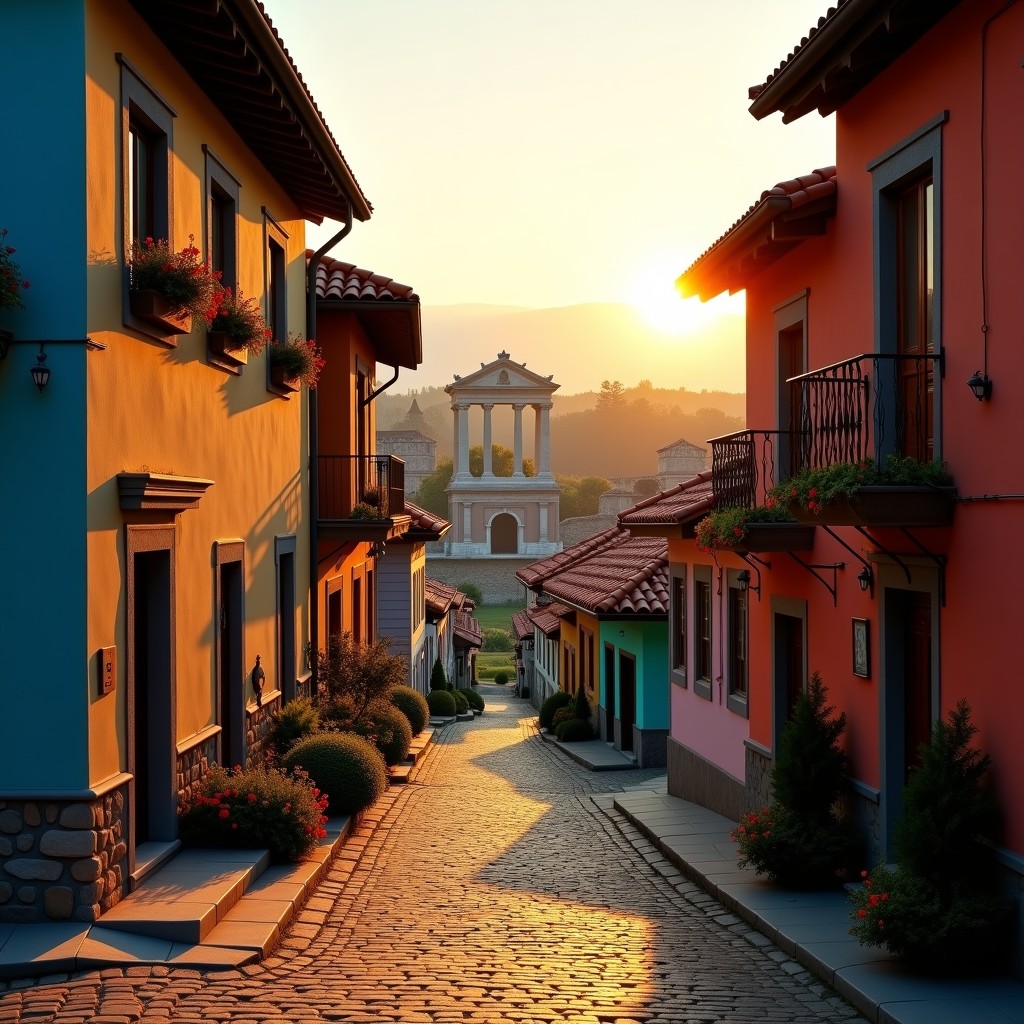
Koprivshtitsa is the jewel of Bulgarian Revival architecture, a town in the Sredna Gora mountains where every house is painted in deep blues, ochres, and reds, with overhanging upper floors and carved wooden ceilings. The town was the starting point of the April Uprising of 1876 against Ottoman rule — the first shot was fired on the Kalachev Bridge — and the six house-museums scattered around town tell that story through original furniture, weapons, and personal effects of the revolutionaries.
The drive from Plovdiv takes about 1 hour 45 minutes via the A1 motorway west to Pazardzhik, then north on winding mountain roads through the Sredna Gora. The final 30 km climb through forested hills is gorgeous in spring and autumn. Parking in Koprivshtitsa is at the main square (5 BGN for the day). A combined ticket for all six house-museums costs 10 BGN. The town is compact — everything is walkable — and you can cover the highlights in 3–4 hours at a relaxed pace. For a meal, Dyado Liben restaurant on the main street serves traditional dishes in a 19th-century house with a garden terrace that catches the afternoon sun.
Time needed: 7–8 hours. Leave Plovdiv by 08:30 to maximise time in the mountain light.
Day Trip 4: The Rose Valley — Kazanlak and the Shipka Pass (220 km round trip, full day)
Bulgaria produces 70% of the world’s rose oil, and the Rose Valley between Kazanlak and Karlovo is where it comes from. From Plovdiv, drive north via Karlovo (1 hour) and enter the valley, where the pink Rosa Damascena blooms blanket the fields between mid-May and mid-June. Even outside rose season, the valley is stunning — a flat corridor between the Balkan mountains to the north and Sredna Gora to the south, with Thracian tombs dotting the landscape.
In Kazanlak, the Thracian Tomb (UNESCO World Heritage, 4th century BC) is a replica — the original is sealed for preservation — but the frescoes are faithfully reproduced and the burial chamber’s beehive dome is a marvel of ancient engineering. From Kazanlak, drive north towards the Shipka Pass, the most dramatic mountain road in central Bulgaria. The 26 km climb up to 1,190 metres has 17 major hairpin bends, each one revealing a wider view of the valley below. At the top, the Shipka Memorial Church’s golden domes gleam against the mountain sky — a Russian Orthodox church built to commemorate the Bulgarian and Russian soldiers who died defending the pass in the 1877–78 Russo-Turkish War.
Time needed: 8–9 hours. The Shipka Pass road is open year-round but can be icy in December–February. Bulgarian winter tyre rules apply November–March.
Day Trip 5: Rhodope Mountain Villages — Shiroka Laka and the Devil’s Throat Cave (200 km round trip, full day)
For a completely different Bulgaria, head south from Plovdiv into the Rhodope Mountains. The road to Smolyan (1 hour 30 minutes) climbs steadily past Bachkovo Monastery into an alpine landscape of pine forests and deep gorges. Turn off for the village of Shiroka Laka — one of Bulgaria’s most perfectly preserved Rhodope villages, where every house is built in the distinctive Rhodope style: stone ground floors, timber upper levels, and slate roofs. Shiroka Laka is famous for its kukeri (winter masked dancers) and its school of folk music, and on a quiet weekday you can hear the sound of bagpipes drifting from the music school.
From Shiroka Laka, the Devil’s Throat Cave is a 30-minute drive to Trigrad. The cave features a 42-metre underground waterfall — the highest on the Balkan Peninsula — and according to legend, this is where Orpheus descended into the underworld. The walk through the cave takes about 45 minutes (entry 10 BGN). The road into Trigrad itself passes through the Trigrad Gorge, where 300-metre limestone walls narrow to barely 100 metres apart — one of the most impressive drives in Bulgaria.
Time needed:–10 hours. Start early — the mountain light is best in the morning, and fog often rolls into the gorges after 16:00.
Practical Day Trip Tips
- Bulgarian vignette: All motorways and most national roads require a vignette — €7 for a 7-day e-vignette. Buy it at any petrol station, border crossing, or online at bgtoll.bg.
- Fuel: Around €1.35 per litre (April 2026). Fill up in Plovdiv before heading into the Rhodopes — petrol stations are sparse in the mountains.
- Road conditions: A1 motorway is excellent. Mountain roads to Koprivshtitsa and the Rhodopes are well-paved but narrow with occasional potholes. The Shipka Pass road is fully paved and regularly maintained.
- Best seasons: May–June for the Rose Valley in bloom. September–October for golden autumn colours in the Rhodopes and Koprivshtitsa. Winter trips to the Rhodopes require snow chains and four-wheel drive.
- Speed limits: 140 km/h on motorways, 90 km/h on open roads, 50 km/h in villages. Speed cameras are common on the A1 and at village entrances — fines are enforced and collected on the spot by traffic police.
FAQ: Plovdiv Day Trips by Car
What’s the best day trip from Plovdiv by car?
For a half-day trip, Bachkovo Monastery and Asen’s Fortress are unbeatable — just 25 minutes south and the Rhodope mountain setting is stunning. For a full day, Koprivshtitsa is Bulgaria’s most beautiful Revival-era town, 1 hour 45 minutes away through the Sredna Gora mountains.
Do I need a vignette for driving around Plovdiv?
Yes. All motorways and most national roads in Bulgaria require a vignette. A 7-day e-vignette costs €7. You can buy it at petrol stations, border crossings, or online at bgtoll.bg. Driving without one carries a fine of 300 BGN (€150).
Can I drive to the Shipka Pass from Plovdiv?
Yes — the drive from Plovdiv to the Shipka Pass via Kazanlak is about 2 hours each way. The pass road climbs 1,190 metres with 17 hairpin bends and is fully paved. The Shipka Memorial Church at the top is one of Bulgaria’s most photogenic landmarks.
Is the Rose Valley worth visiting outside rose season?
Yes. Even without the blooming fields (mid-May to mid-June), the Kazanlak area has the UNESCO-listed Thracian Tomb, the Shipka Memorial Church, and dramatic mountain scenery. The Thracian tomb replica is open year-round and the frescoes are remarkable in any season.
Are the Rhodope mountain roads safe to drive?
The roads to Bachkovo, Shiroka Laka, and Trigrad are well-paved two-lane mountain roads. They’re narrow in sections and you should drive cautiously around blind corners — local drivers tend to overtake aggressively. Winter driving (November–March) requires snow chains or winter tyres by law. Outside winter, the roads are perfectly manageable for a careful driver.
Related Destinations
Driving further afield from Plovdiv? Check out our Plovdiv to Varna drive guide across Bulgaria to the Black Sea, our complete guide to driving in Bulgaria, and car hire in Sofia for exploring the capital region.
Ready to book? Visit our homepage for the best hire car deals.