

Plovdiv to Varna Drive | From €14/day | BG Car Rental
Bulgaria rewards road trippers who take the long way around. The 300-kilometre drive from Plovdiv to Varna cuts through the heart of the country — past ancient Roman ruins, through the Balkan Mountains, across the vast Thracian Plain, and down to the Black Sea coast. It’s one of Bulgaria’s most scenically diverse routes, and driving it gives you access to places that the main Sofia–Varna rail line simply doesn’t reach.
Why Drive Plovdiv to Varna?
Plovdiv is Bulgaria’s second-largest city and one of Europe’s oldest continuously inhabited settlements — its Old Town features Roman amphitheatre ruins carved into the hillside. Varna is the country’s maritime capital, a Black Sea city of 470,000 people with beaches, a cathedral, and the famous Sea Garden waterfront. Between them lies the Stara Zagora plain, the Shipka Pass through the Balkan Mountains, and the Rose Valley in season.
The route connects two of Bulgaria’s most important cities in a way that gives you the full geographic breadth of the country. Whether you’re based in Plovdiv and heading to the coast for a long weekend, or you’re flying into Varna Airport and want to explore the interior, the Plovdiv to Varna drive is the logical route between these two hubs.
The Route: Two Main Options
The Main Route: Trakia Motorway (A1) and I-2
The most direct route follows the Trakia Motorway (A1) from Plovdiv east toward Stara Zagora, then continues on the I-2 national road north through the Shipka Pass and on to Varna. Total distance is approximately 300 kilometres, with a driving time of 3 hours 30 minutes to 4 hours without stops.
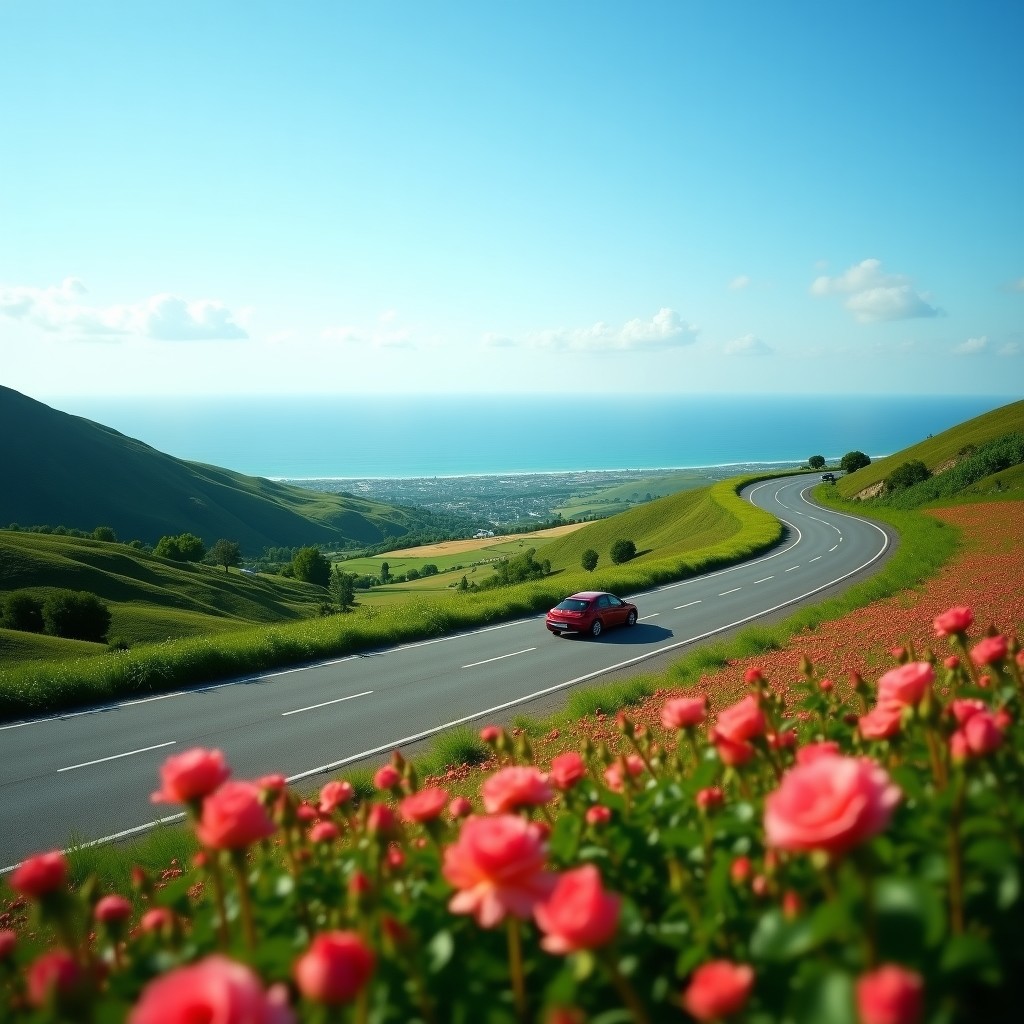
This route passes through the Thracian Plain — flat, agricultural land growing wheat, sunflowers, and (in the Rose Valley section near Kazanlak) the roses that produce Bulgarian rose oil, one of the country’s most famous exports. In late May and early June, the rose fields are extraordinary — if you’re driving through in that window, it’s worth stopping at one of the rose farms near Kazanlak for a guided tour and rose products.
The Shipka Pass section requires some attention — the road climbs to around 1,200 metres elevation through the Balkan Mountains. The road is generally in good condition but has curves and gradients. In winter (December through February), ice and snow can make the pass challenging — check conditions before departing and consider snow chains if you’re driving in cold weather.
The Scenic Route: Via the Black Sea Coast
A longer but dramatically more scenic option is to head east from Plovdiv to Bourgas on the coast, then follow the Black Sea coastline north to Varna. This adds roughly 60-80 kilometres and 1-1.5 hours of driving time, but the Bourgas to Varna coastal section is one of Bulgaria’s most attractive drives — the road passes through the sand dunes and wetlands of the Pomorie and Ravda coast, past the ancient towns of Nessebar (a UNESCO World Heritage Site) and Sozopol, and along the clifftop sections north of Byala.
Nessebar alone is worth a two-hour stop — the old town is a compact maze of Byzantine stone churches, Ottoman-era houses, and medieval walls sitting on a rocky peninsula connected to the mainland by a narrow causeway. Parking costs around €2-3 per hour in high season. Sozopol, further south, has a similar character but with a stronger artistic identity — it’s been an artists’ colony since the 1920s.
Key Stops Along the Plovdiv to Varna Route
Kazanlak: Rose Capital and Thracian Tombs
Kazanlak is the centre of Bulgaria’s rose oil industry — the surrounding Rose Valley produces around 70% of the world’s rose oil used in perfume. The town is also home to a UNESCO-listed Thracian tomb with well-preserved frescoes dating to the 4th century BC. The Museum of Roses at Kazanlak explains the entire rose oil production process — it’s a fascinating 45-minute visit, and rose water and rose oil are available for purchase at very reasonable prices compared to European boutiques.
Kazanlak is on the main A1/I-2 route — a 40-minute detour from the highway. It’s well signposted.
Shipka and the Shipka Pass
The Shipka Pass is one of Bulgaria’s most historically significant locations. The Battle of Shipka (1877) was a pivotal conflict in Bulgaria’s liberation from Ottoman rule, and the imposing Shipka Memorial (Sheitan将军?) sits at the pass — a massive stone structure you can climb for panoramic views across the Balkan Mountains. There’s a small museum adjacent to the memorial. The pass itself is at approximately 1,200 metres elevation. The road is generally well-maintained but has sharp curves on the ascent and descent.
Veliko Tarnovo: Detour Worth Taking
Technically off the direct Plovdiv–Varna route (it’s about 40 kilometres north of the I-2 at Sevlievo), Veliko Tarnovo is Bulgaria’s medieval capital and one of the most dramatically situated cities in Eastern Europe. The old town cascades down a steep hillside to the Yantra River, overlooked by the ruins of Tsarevets Fortress. If you have an extra 2-3 hours, the detour is absolutely worth it — park near the old town and wander the craftsman streets, visit the fortress, and eat at one of the riverside restaurants.
Nessebar and Sozopol (Scenic Route Only)
If you’re taking the coastal route, both Nessebar and Sozopol are essential stops. Nessebar’s old town is a UNESCO site — allow 1.5-2 hours. Sozopol is smaller and more intimate — good for lunch and a walk along the harbour. Both towns get very crowded in July and August — arrive before 10am or consider visiting in shoulder season (May-June or September).
Tolls, Fuel, and Driving Costs
Bulgaria’s Vignette system covers the Trakia Motorway A1 — you’ll need a vignette (€7 for one week, €14 for a month) to use it legally. Vignettes are sold at petrol stations approaching the motorway and at border crossings. Failing to display a valid vignette results in on-the-spot fines of several hundred lev.
Fuel prices in Bulgaria are among the lowest in Europe. Diesel costs approximately €1.30-1.40 per litre; petrol (95 octane) is around €1.35-1.45 per litre. The fuel quality is good at major stations — Lukoil, Shell, and EKO have reliable fuel across the route. Petrol stations are plentiful on the A1 but can be spaced 30-40 kilometres apart on the coastal I-2 road, so fill up before leaving major towns.
Driving Conditions and Road Quality
Bulgarian driving has a reputation — and it’s partially deserved. The main roads (A1, I-2) are in reasonably good condition with smooth surfaces and clear markings. Secondary roads can be patchy — watch for potholes, especially after winter frost damage. The coastal road (I-9) north of Bourgas is narrow in places and passes through numerous small towns where speeds naturally drop.
Police speed checks are common on Bulgarian roads, particularly on the A1 and approaching Varna. Speed limits are 130 km/h on motorways, 90 km/h on open roads, and 50 km/h in urban areas. Fines are payable on the spot in cash (preferred) or card — always ask for a receipt.
In terms of documentation, EU driving licences are accepted directly. Non-EU visitors should carry an International Driving Permit alongside their national licence. Your rental company will provide the mandatory third-party liability insurance — comprehensive cover is recommended for drivers unfamiliar with Bulgarian road conditions.
Car Hire: Plovdiv vs Varna Airport
Plovdiv Airport (Podem) is served by a handful of seasonal international flights, but most travellers pick up their rental car in Plovdiv city centre or at Sofia Airport and drive down. Varna Airport is Bulgaria’s second-busiest aviation hub and has good car hire coverage — Sixt, Budget, and local suppliers have desks in the terminal.
One-way rentals between Plovdiv and Varna are possible with most suppliers, though an additional drop-off fee typically applies. Book in advance, particularly in summer, to secure the best vehicle and rate. Our comparison shows all available suppliers and their current pricing — with no hidden fees and free cancellation included as standard.
What to Expect Seasonally
The Plovdiv to Varna drive changes dramatically with the seasons. Summer (June-August) is peak season — the coastal sections around Nessebar and Sozopol can be extremely busy, and finding parking in towns is challenging. Autumn (September-October) is arguably the best time — warm days (20-25°C), empty beaches, the rose harvest is over and prices have normalised.
Winter driving is straightforward on the main A1/I-2 route but requires care on the Shipka Pass in snow and ice. Spring (April-May) is pleasant — the rose fields around Kazanlak are in bloom in May, which is a spectacular time to drive the route.
Summary
The Plovdiv to Varna drive is a 300-kilometre journey through Bulgaria’s most varied landscapes. The main route via the A1 and I-2 takes 3.5-4 hours and passes through the Rose Valley, the Shipka Pass, and the Thracian Plain. The scenic coastal route adds 60-80 kilometres and 1-1.5 hours but rewards you with the UNESCO old town of Nessebar, the artist town of Sozopol, and clifftop Black Sea driving north of Byala.
Book your rental car through our comparison to compare all major suppliers currently available for this route — and find a vehicle suited to whatever season you’re travelling in.
## Related Destinations
Looking for car hire nearby? Also explore car hire in Plovdiv, car hire in Varna, Sofia Airport car hire, and driving in Bulgaria guide.
## Plovdiv to Varna Drive: Frequently Asked Questions
How far is Plovdiv to Varna by car?
The main route via the A1 Trakia Motorway and I-2 road covers approximately 300 kilometres and takes 3 hours 30 minutes to 4 hours of driving time. The scenic coastal route via Bourgas adds 60-80 kilometres and roughly 1-1.5 hours extra.
Do I need a vignette for the Plovdiv to Varna drive?
Yes — the A1 Trakia Motorway requires a Bulgarian vignette (€7 for one week, €14 for a month). Vignettes must be displayed on your windscreen. The I-2 national road does not require a vignette. Some tunnels on the I-2 coastal section charge small toll fees.
What is the most scenic way to drive Plovdiv to Varna?
The coastal route via Bourgas, Nessebar, and Sozopol is significantly more scenic than the direct A1/I-2 route. It’s an extra 60-80 kilometres and 1-1.5 hours but includes UNESCO-listed Nessebar, the harbour town of Sozopol, and dramatic Black Sea cliff sections north of Byala.
When is the best time to drive this route?
Late May and early June are spectacular — the Rose Valley around Kazanlak is in bloom and the coastal towns are not yet crowded. September offers warm weather with empty beaches. Summer (July-August) is peak season with heavy traffic and full accommodation. Winter is manageable on the main route but requires caution on the Shipka Pass in snow.
Can I visit Veliko Tarnovo on the Plovdiv to Varna drive?
Veliko Tarnovo is about 40 kilometres north of the I-2 (via Sevlievo) — it’s a significant detour adding roughly 2-3 hours including the visit. But it’s one of Bulgaria’s most impressive cities, dramatically set on a hillside above the Yantra River, and worth the detour if you have the time.
Ready to book? Visit our homepage for the best hire car deals.